
Trading and gambling both involve risk and uncertain outcomes, but they differ markedly in execution and control. Trading employs analytical frameworks, risk management tools like position sizing and stop orders, and relies on market data for strategic decision-making online casino Malaysia. Gambling depends primarily on chance and fixed probabilities with limited skill impact. Psychological biases affect both, yet disciplined trading can yield consistent returns, contrasting gambling’s inherent expected losses. Exploring these distinctions reveals deeper insights into speculation and market behavior.

Understanding the Basics of Trading
In examining the fundamentals of trading, it is essential to define its core mechanisms and objectives. Trading operates within market mechanics that facilitate the exchange of financial instruments, relying on diverse order types such as market, limit, and stop orders to execute transactions efficiently. These order types influence liquidity effects, as they determine the availability and timing of asset exchanges MMC996 Malaysia, directly impacting market depth and price stability. Additionally, fee structures contribute materially to trading dynamics by affecting transaction costs and potentially altering trader behavior. Understanding these components enables innovators to optimize trading platforms, enhance transparency, and reduce friction. By analyzing empirical data on market responses to various fee models and order executions, stakeholders can develop systems that balance efficiency with accessibility, fostering more robust and adaptive financial markets.
Key Characteristics of Gambling
At the core of gambling lies the deliberate risk-taking on uncertain outcomes, governed by predefined rules and probability structures. Key characteristics include the predominance of chance elements, where outcomes are largely unpredictable despite statistical probabilities. Gambling activities operate within strict regulatory frameworks designed to guarantee fairness, transparency, and consumer protection. These frameworks often mandate licensing, auditing, and adherence to standardized payout rates, reflecting a systemic approach to managing randomness. The interaction between chance and regulation differentiates gambling from other speculative activities, emphasizing reliance on probabilistic models rather than skill or information asymmetry. Quantitative analyses consistently highlight the inherent volatility and expected negative returns for participants, underscoring gambling’s distinct risk profile. Such objective criteria provide a foundation for innovative discourse on its relationship with trading.
Risk Management in Trading Versus Gambling
While gambling is characterized by fixed probabilistic frameworks that dictate outcomes and expected losses, trading operates within a more dynamic environment where risk management strategies are actively employed to influence potential returns. Traders utilize position sizing to control exposure relative to capital, effectively limiting downside risk with each trade. Stop placement serves as a tactical tool to automatically exit positions when losses exceed predetermined thresholds, preserving capital and enabling iterative adjustments. Empirical data indicates that disciplined risk management can reduce volatility in trading portfolios, contrasting with the inherent variance in gambling outcomes. This structured approach allows traders to adapt to evolving market conditions, optimizing risk-reward profiles. Consequently, risk management in trading introduces a systematic framework absent in gambling’s static probability models, underscoring fundamental operational differences between the two activities.
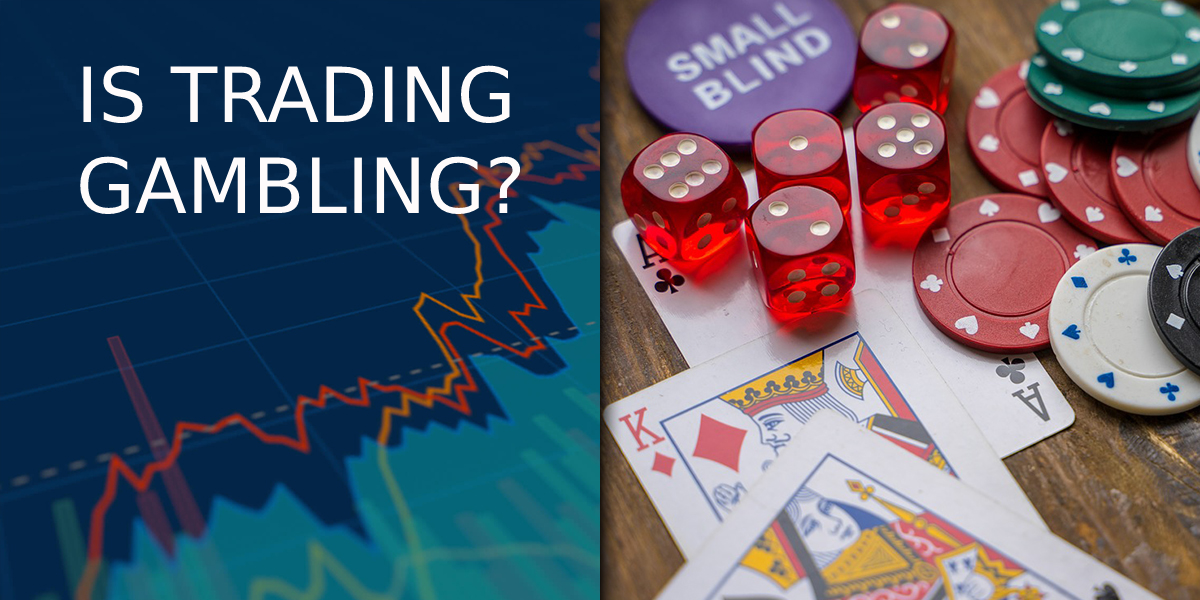
The Role of Skill and Strategy in Both Activities
Regarding the role of skill and strategy, trading and gambling exhibit fundamentally different characteristics. Trading relies heavily on analytical frameworks, incorporating position sizing to optimize risk-reward ratios based on market conditions. Traders develop market intuition through data analysis and pattern recognition, enabling adaptive decision-making. Conversely, gambling outcomes predominantly depend on chance, with limited strategic influence beyond bankroll management. Empirical studies indicate that skillful trading can yield consistent alpha, while gambling’s expected value remains negative over time. Innovations in algorithmic trading further emphasize the strategic dimension through quantitative models, contrasting with the stochastic nature of gambling. Consequently, while both involve risk, trading’s reliance on skillful position sizing and market intuition differentiates it from gambling’s primarily probabilistic structure.
Psychological Factors Influencing Traders and Gamblers
The distinction between trading and gambling extends beyond skill and strategy into the domain of psychological influences shaping participant behavior. Both activities are susceptible to behavioral biases and challenges in emotional regulation, impacting decision-making processes. Empirical data suggests that traders employing systematic emotional regulation techniques outperform impulsive counterparts, whereas gamblers often exhibit increased risk-taking under emotional stress. Key psychological factors include:
- Overconfidence bias leading to excessive risk exposure
- Loss aversion causing premature exit or irrational persistence
- Confirmation bias reinforcing flawed strategies
- Emotional regulation capacity dictating response to market or game volatility
Innovative frameworks integrating behavioral finance principles aim to mitigate these biases, enhancing performance predictability. Understanding such psychological dynamics is essential to delineate the nuanced boundary between trading as a skill-based endeavor and gambling as speculative risk-taking.
Conclusion
Trading and gambling share elements of risk and uncertainty; however, empirical analysis highlights distinct differences. Trading incorporates structured risk management, strategic decision-making, and reliance on market data, whereas gambling mainly depends on chance with limited skill influence. Psychological factors such as risk tolerance and cognitive biases affect participants in both domains, yet the potential for informed, data-driven strategies in trading differentiates it from gambling’s probabilistic nature. Consequently, trading cannot be simplistically equated to gambling.